United States Army Medical Research Institute of Infectious Diseases
The Passage (Justin Cronin Edition)The United States Army Medical Research Institute of Infectious Diseases (USAMRIID) is a military research institution at the junction of scientific inquiry and state power. Its investigators pursue an unexplained illness, while its funding and classified projects place research inside a chain of military decisions whose consequences extend far beyond the laboratory.
Institutional Identity and Reach
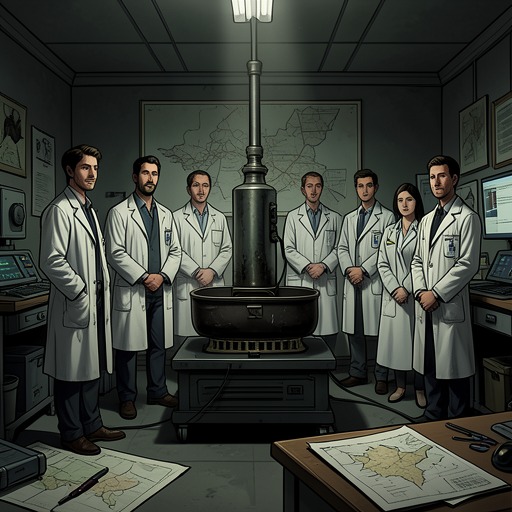
Jonas Abbott Lear’s files identify him as a professor of molecular and cellular biology at Harvard University, assigned to USAMRIID’s Department of Paleovirology at Fort Derrick, Maryland. The archival framing establishes that Lear’s research is being conducted within an Army medical-research structure, rather than as an entirely independent academic inquiry. The institution’s reach includes scientific investigation, military funding, and the security apparatus surrounding the work.
That reach becomes explicit when Lear recounts the arrival of Mark Cole at an expedition base camp. A Special Forces squad accompanies Cole, who tells Lear that the civilian scientific expedition has been militarized and that Lear has become a major. Lear protests that it is a civilian expedition; Cole answers that the decision came from the President. The exchange makes USAMRIID’s funding a turning point: Lear recognizes that accepting its money has helped bring the expedition under military control. The institution does not appear simply as a laboratory issuing commands, but as the point through which scientific work becomes available to national-security priorities.
Investigation and the Bolivian Expedition
The expedition’s urgency grows from reports of four American patients in La Paz. About ten years before the account given to Bradford Wolgast, the patients developed symptoms resembling hantavirus after an ecotour in the jungle. They said they had been part of a group of fourteen, separated from the others, and lost for weeks before reaching a remote trading post. Their terminal cancer diagnoses made the episode unusually significant to investigators: the illness appeared in patients whose circumstances had already made them subjects of a specialized tour organized by Last Wish.
The investigation leads toward a grave site and an attempted extraction, but the field team’s account records a worsening crisis before that objective can be completed. Lear writes that the group is less than five kilometers from the site and doubts they can proceed as planned because too many team members are sick or dead. Bats attack the camp after sunset. Four people die in the first attack, including Claudia Swenson; others are bitten or scratched and develop a rapidly progressing illness. Tim Fanning is among the seriously ill. In a later attack, a large swarm overwhelms the soldiers’ defenses, killing three soldiers and Cole. Lear’s account turns the expedition from a controlled research operation into a struggle to survive, while leaving the intended extraction unresolved in the evidence presented here.
From Research to Project NOAH
The institutional connection to the later crisis is made concrete in the account of Project NOAH. Sykes tells Wolgast that the Army needs between ten and twenty death-row inmates for third-stage trials of an experimental drug therapy. Wolgast is tasked with obtaining their signatures in return for commutation of their sentences to life without parole. Because the project is a matter of national security, the participants are to be declared legally dead and placed under assumed identities in a federal penal-system camp. The proposed subjects are men aged twenty to thirty-five with no living first-degree relatives.
This arrangement shows how research ethics and state secrecy converge around USAMRIID’s work. Consent is formally sought, and the arrangement has been legally vetted, but the participants’ removal from public life is built into the project’s security design. The institution’s research program therefore depends on a system that makes the trial subjects difficult to trace and the project difficult to scrutinize. The later explanation of the original patients’ history connects this classified experimentation to the earlier investigation without reducing the institution to a single motive: it is at once a scientific body studying disease and part of a national-security project that conceals the people enrolled in its trials.
Records, Signals, and Institutional Afterlife
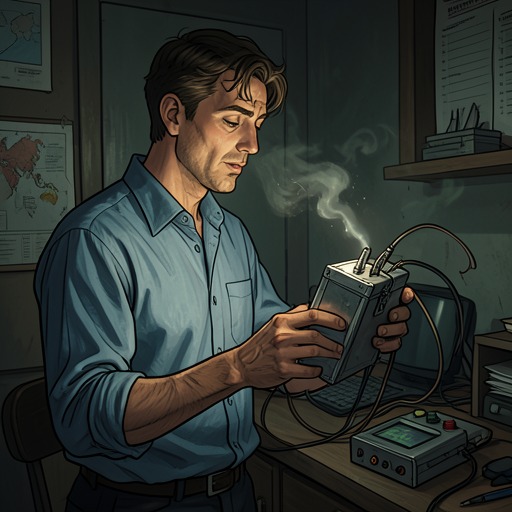
Long after the original research, the letters and technical records associated with USAMRIID retain the power to explain what happened. Michael recognizes the abbreviation on material in a shed and identifies it as the United States Army Medical Research Institute for Infectious Diseases. When he examines Amy’s transmitter, he finds the designation among the device’s data; another partition contains nearly sixteen terabytes of information. He interprets repeated figures as a clue to decoding the data and identifies the transmitter’s locator information as latitude and longitude, turning an old military device into a route toward the history encoded in it.
That information is not merely a surviving archive. The transmitter data associates Amy with USAMRIID and with Project NOAH, while the institution’s records help connect a child’s device to the earlier military research program. In the later world, the name survives amid broken communication and fading infrastructure: Michael’s account describes batteries nearing the end of their service life and a radio ban established after transmissions once led Walkers to the Colony. The contrast is sharp. The institution’s archived knowledge can still cross decades, but the communities inheriting it have limited means to communicate or maintain their systems.
USAMRIID’s significance lies in this double legacy. Its research helps make the crisis legible, and its files eventually provide clues to the origins of Amy’s transmitter and Project NOAH. Yet the military control, secrecy, and restricted access surrounding the research also separate scientific knowledge from public understanding. The institution thus stands as both a source of explanation and part of the machinery that keeps the explanation concealed.